
95. Unique Binary Search Trees II
Problem
Given an integer n, return all the structurally unique BST’s (binary search trees), which has exactly n nodes of unique values from 1 to n. Return the answer in any order.
https://leetcode.com/problems/unique-binary-search-trees-ii/
Example 1:
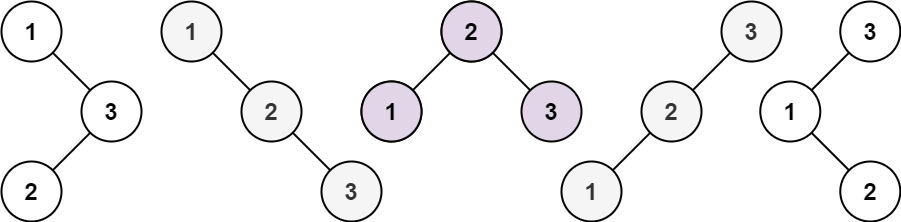
Input:
n = 3
Output:[[1,null,2,null,3],[1,null,3,2],[2,1,3],[3,1,null,null,2],[3,2,null,1]]
Example 2:
Input:
n = 1
Output:[[1]]
Constraints:
1 <= n <= 8
Test Cases
# Definition for a binary tree node.
# class TreeNode:
#     def __init__(self, val=0, left=None, right=None):
#         self.val = val
#         self.left = left
#         self.right = right
class Solution:
def generateTrees(self, n: int) -> List[Optional[TreeNode]]:solution_test.py下载完整源码
import pytest

import os
import sys
sys.path.append(os.path.dirname(os.path.dirname(__file__)))
from _utils.binary_tree import print_tree
from solution import Solution
from solution2 import Solution as Solution2

null = None


@pytest.mark.parametrize('n, expected', [
    (3, [[1,null,2,null,3],[1,null,3,2],[2,1,3],[3,1,null,null,2],[3,2,null,1]]),
    (1, [[1]]),
])
@pytest.mark.parametrize('sol', [Solution(), Solution2()])
def test_solution(sol, n, expected):
    result = sol.generateTrees(n)
    result = [print_tree(root) for root in result]
    result.sort()
    assert result == sorted(expected)
Thoughts
跟 96. Unique Binary Search Trees 一样,只不过这里是要列举出所有可能的 BST 来(这回不能直接用卡塔兰数的数学公式了)。
用递归来实现吧,借助 Python 内置的 functools.cache 缓存一些中间结果来加速(甚至复用一些二叉树节点)。
当然也可以用循环来做,自己维护缓存 dp[i][j] 记录从 i 到 j 的所有 BST。循环的时候,第一重对子问题的规模循环,可以避免引用到尚未计算的 dp。
Code
Recursively
solution.py下载完整源码
from functools import cache
from itertools import product
from typing import Optional


# Definition for a binary tree node.
class TreeNode:
    def __init__(self, val=0, left=None, right=None):
        self.val = val
        self.left = left
        self.right = right


class Solution:
    def generateTrees(self, n: int) -> list[Optional[TreeNode]]:
        @cache
        def gen(i: int, j: int) -> list[TreeNode]:
            if i == j: return [TreeNode(i)]
            elif i > j: return [None]

            trees = []
            for k in range(i, j + 1):
                left = gen(i, k - 1)
                right = gen(k + 1, j)
                for l, r in product(left, right):
                    trees.append(TreeNode(k, l, r))

            return trees

        return gen(1, n)
Iteratively
solution2.py下载完整源码
from itertools import product
from typing import Optional


# Definition for a binary tree node.
class TreeNode:
    def __init__(self, val=0, left=None, right=None):
        self.val = val
        self.left = left
        self.right = right


class Solution:
    def generateTrees(self, n: int) -> list[Optional[TreeNode]]:
        # dp[i][j]: all trees for i...j
        dp = [[[None] for _ in range(n + 2)] for _ in range(n + 2)]
        for size in range(1, n + 1):
            for i in range(1, n - size + 2):
                j = i + size - 1
                trees = []
                for k in range(i, j + 1):
                    for l, r in product(dp[i][k-1], dp[k+1][j]):
                        trees.append(TreeNode(k, l, r))

                dp[i][j] = trees

        return dp[1][n]
评论需要 JavaScript。