
743. Network Delay Time
Problem
You are given a network of n nodes, labeled from 1 to n. You are also given times, a list of travel times as directed edges times[i] = (uᵢ, vᵢ, wᵢ), where uᵢ is the source node, vᵢ is the target node, and wᵢ is the time it takes for a signal to travel from source to target.
We will send a signal from a given node k. Return the minimum time it takes for all the n nodes to receive the signal. If it is impossible for all the n nodes to receive the signal, return -1.
https://leetcode.cn/problems/network-delay-time/
Example 1:
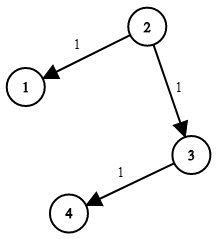
Input:
times = [[2,1,1],[2,3,1],[3,4,1]], n = 4, k = 2
Output:2
Example 2:
Input:
times = [[1,2,1]], n = 2, k = 1
Output:1
Example 3:
Input:
times = [[1,2,1]], n = 2, k = 2
Output:-1
Constraints:
1 <= k <= n <= 1001 <= times.length <= 6000times[i].length == 31 <= uᵢ, vᵢ <= nuᵢ != vᵢ0 <= wi <= 100- All the pairs
(uᵢ, vᵢ)are unique. (i.e., no multiple edges.)
Test Cases
class Solution:
def networkDelayTime(self, times: List[List[int]], n: int, k: int) -> int:import pytest
from solution import Solution
@pytest.mark.parametrize('times, n, k, expected', [
([[2,1,1],[2,3,1],[3,4,1]], 4, 2, 2),
([[1,2,1]], 2, 1, 1),
([[1,2,1]], 2, 2, -1),
])
class Test:
def test_solution(self, times, n, k, expected):
sol = Solution()
assert sol.networkDelayTime(times, n, k) == expected
Thoughts
记信号传输到节点 i 所需的最小时间为 c(i)。初始时 c(k) = 0,其他均为 ∞。
从节点 k 出发遍历图。如果信号从 u 传播到 v,易知 c(v) = min{c(v), c(u) + w(u, v)}。如果 c(v) 被更新(发现了能更快传播到 v 的路径),继续递归处理 v 的下游节点。
使用广度优先遍历有可能得到更多的剪枝,广度优先可以用队列。尤其如果使用带优先级的队列,每次处理信号最早到达的节点,能加大剪枝的概率。最小堆是很适合的数据结构,堆顶就是最快到达的节点,每次把堆顶推出。
做完 2290. Minimum Obstacle Removal to Reach Corner 发现其实就是实现了 Dijkstra 算法(基于优先队列优化的)。
时间复杂度 O((e + n) log n)(每个节点进入队列时要恢复堆的结构),空间复杂度 O(n)(队列大小)。e 是边的数量,即 times 数组的长度。
Code
这里直接借助 Python 自带的 heapq 辅助堆的操作。
from heapq import heappop, heappush


class Solution:
    def networkDelayTime(self, times: list[list[int]], n: int, k: int) -> int:
        # adjacencies[u]: list of (v, w).
        adjacencies: list[list[tuple[int, int]]] = [[] for _ in range(n)]
        for u, v, w in times:
            adjacencies[u-1].append((v-1, w))

        costs = [-1] * n
        costs[k-1] = 0
        queue = [(0, k-1)]
        while queue:
            c_u, u = heappop(queue)
            if c_u > costs[u]: # Pruning.
                continue

            for v, w in adjacencies[u]:
                if (c_v := costs[u] + w) < costs[v] or costs[v] == -1:
                    costs[v] = c_v
                    heappush(queue, (c_v, v))

        max_cost = -1
        for c in costs:
            if c == -1:
                return -1
            elif c > max_cost:
                max_cost = c

        return max_cost
评论需要 JavaScript。