
42. Trapping Rain Water
Problem
Given n non-negative integers representing an elevation map where the width of each bar is 1, compute how much water it can trap after raining.
https://leetcode.com/problems/trapping-rain-water/
Example 1:
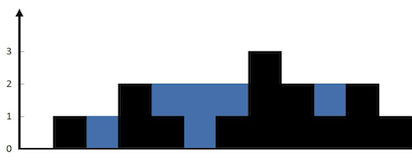
Input:
height = [0,1,0,2,1,0,1,3,2,1,2,1]
Output:6
Explanation: The above elevation map (black section) is represented by array[0,1,0,2,1,0,1,3,2,1,2,1]. In this case, 6 units of rain water (blue section) are being trapped.
Example 2:
Input:
height = [4,2,0,3,2,5]
Output:9
Constraints:
n == height.length1 <= n <= 2 * 10⁴0 <= height[i] <= 10⁵
Test Cases
class Solution:
def trap(self, height: List[int]) -> int:import pytest
from solution import Solution
@pytest.mark.parametrize('height, expected', [
([0,1,0,2,1,0,1,3,2,1,2,1], 6),
([4,2,0,3,2,5], 9),
])
@pytest.mark.parametrize('sol', [Solution()])
def test_solution(sol, height, expected):
assert sol.trap(height) == expected
Thoughts
对于任意位置 i(0 ≤ i < n),记 l_max(i) = max{height[:i+1]}(i 及其左边最高的 bar),r_max(i) = max[height[i:]](i 及其右边最高的 bar)。取 bound = min{l_max(i), r_max(i)},显然 bound ≥ height[i]。如果 bound > height[i],那么高出来的部分(bound - height[i])都是可以有水的。
先从右向左遍历 height,记录所有的 r_max(i)。然后从左向右遍历,一边更新 l_max(i) 一边计算位置 i 的积水量,并累计总积水量。
时间复杂度 O(n),空间复杂度 O(n)。
Code
class Solution:
    def trap(self, height: list[int]) -> int:
        max2 = lambda a, b: a if a >= b else b
        min2 = lambda a, b: a if a <= b else b

        n = len(height)
        r_maxes = [0] * n
        r_maxes[-1] = height[-1]
        for i in range(n - 2, -1, -1):
            r_maxes[i] = max2(r_maxes[i + 1], height[i])

        total = 0
        l_max = height[0]
        for i in range(1, n - 1):
            l_max = max2(l_max, height[i])
            bound = min2(l_max, r_maxes[i])
            if bound > height[i]:
                total += bound - height[i]

        return total
空间复杂度可以降到 O(1),时间复杂度的系数也可以在降低,TODO。
评论需要 JavaScript。