GoCalf Calf 的自留地 · 昙花一现

3242. Design Neighbor Sum Service

Problem

You are given a n x n 2D array grid containing distinct elements in the range [0, n² - 1].

Implement the NeighborSum class:

  • NeighborSum(int [][]grid) initializes the object.
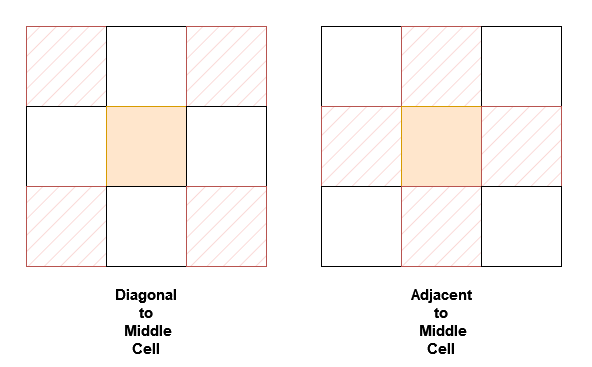
  • int adjacentSum(int value) returns the sum of elements which are adjacent neighbors of value, that is either to the top, left, right, or bottom of value in grid.
  • int diagonalSum(int value) returns the sum of elements which are diagonal neighbors of value, that is either to the top-left, top-right, bottom-left, or bottom-right of value in grid.
problem
problem

https://leetcode.cn/problems/design-neighbor-sum-service/

Example 1:

Input:
["NeighborSum", "adjacentSum", "adjacentSum", "diagonalSum", "diagonalSum"]
[[[[0, 1, 2], [3, 4, 5], [6, 7, 8]]], [1], [4], [4], [8]]
Output: [null, 6, 16, 16, 4]
Explanation:

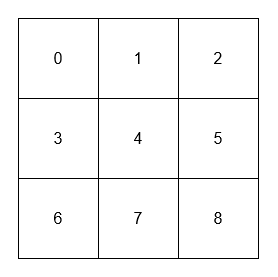
case1
case1
  • The adjacent neighbors of 1 are 0, 2, and 4.
  • The adjacent neighbors of 4 are 1, 3, 5, and 7.
  • The diagonal neighbors of 4 are 0, 2, 6, and 8.
  • The diagonal neighbor of 8 is 4.

Example 2:

Input:
["NeighborSum", "adjacentSum", "diagonalSum"]
[[[[1, 2, 0, 3], [4, 7, 15, 6], [8, 9, 10, 11], [12, 13, 14, 5]]], [15], [9]]
Output: [null, 23, 45]
Explanation:

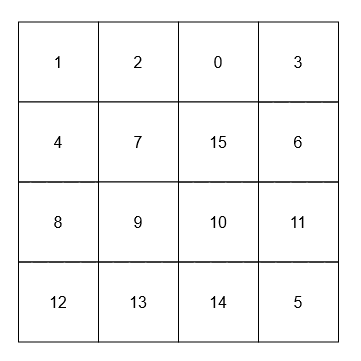
case2
case2
  • The adjacent neighbors of 15 are 0, 10, 7, and 6.
  • The diagonal neighbors of 9 are 4, 12, 14, and 15.

Constraints:

  • 3 <= n == grid.length == grid[0].length <= 10
  • 0 <= grid[i][j] <= n² - 1
  • All grid[i][j] are distinct.
  • value in adjacentSum and diagonalSum will be in the range [0, n² - 1].
  • At most 2 * n² calls will be made to adjacentSum and diagonalSum.

Test Cases

python
class NeighborSum:

    def __init__(self, grid: List[List[int]]):


    def adjacentSum(self, value: int) -> int:


    def diagonalSum(self, value: int) -> int:


# Your NeighborSum object will be instantiated and called as such:
# obj = NeighborSum(grid)
# param_1 = obj.adjacentSum(value)
# param_2 = obj.diagonalSum(value)
solution_test.py下载完整源码
py
import pytest

from solution import NeighborSum


@pytest.mark.parametrize('actions, params, expects', [
    (
        ["NeighborSum", "adjacentSum", "adjacentSum", "diagonalSum", "diagonalSum"],
        [[[[0, 1, 2], [3, 4, 5], [6, 7, 8]]], [1], [4], [4], [8]],
        [None, 6, 16, 16, 4],
    ),
    (
        ["NeighborSum", "adjacentSum", "diagonalSum"],
        [[[[1, 2, 0, 3], [4, 7, 15, 6], [8, 9, 10, 11], [12, 13, 14, 5]]], [15], [9]],
        [None, 23, 45],
    ),
])
def test_neighbor_sum(actions, params, expects):
    ns = None
    for action, param, expected in zip(actions, params, expects):
        if action == 'NeighborSum':
            ns = NeighborSum(*param)
        elif action == 'adjacentSum':
            assert ns.adjacentSum(*param) == expected
        elif action == 'diagonalSum':
            assert ns.diagonalSum(*param) == expected

Thoughts

在初始化的时候直接把所有格子的 adjacentSum 和 diagonalSum 计算好保存下来。

因为元素的值刚好是 0 到 n² - 1,可以直接用作数组,元素值即为数字下标。

每次查询的时间复杂度为 O(1)。

构造的时间复杂度为 O(n²),空间复杂度亦然。

构造的计算有两个方向,一是遍历到一个格子时,计算它的 adjacent 格子和 diagonal 格子的数字之和。 另一是遍历到一个格子时,计算它对周围格子的 adjacentSum 和 diagonalSum 的贡献。

注意矩阵的边界。

Code

py
from typing import List


class NeighborSum:

    def __init__(self, grid: List[List[int]]):
        n = len(grid)
        n2 = n * n
        self._adjacent_sums = [0] * n2
        self._diagonal_sums = [0] * n2

        g = lambda x, y: grid[x][y] if 0 <= x < n and 0 <= y < n else 0

        for i in range(n):
            for j in range(n):
                v = grid[i][j]
                self._adjacent_sums[v] = g(i-1, j) + g(i, j-1) + g(i, j+1) + g(i+1, j)
                self._diagonal_sums[v] = g(i-1, j-1) + g(i-1, j+1) + g(i+1, j-1) + g(i+1, j+1)

    def adjacentSum(self, value: int) -> int:
        return self._adjacent_sums[value]

    def diagonalSum(self, value: int) -> int:
        return self._diagonal_sums[value]


# Your NeighborSum object will be instantiated and called as such:
# obj = NeighborSum(grid)
# param_1 = obj.adjacentSum(value)
# param_2 = obj.diagonalSum(value)

评论需要 JavaScript。