
2658. Maximum Number of Fish in a Grid
Problem
You are given a 0-indexed 2D matrix grid of size m x n, where (r, c) represents:
- A land cell if
grid[r][c] = 0, or - A water cell containing
grid[r][c]fish, ifgrid[r][c] > 0.
A fisher can start at any water cell (r, c) and can do the following operations any number of times:
- Catch all the fish at cell
(r, c), or - Move to any adjacent water cell.
Return the maximum number of fish the fisher can catch if he chooses his starting cell optimally, or 0 if no water cell exists.
An adjacent cell of the cell (r, c), is one of the cells (r, c + 1), (r, c - 1), (r + 1, c) or (r - 1, c) if it exists.
https://leetcode.com/problems/maximum-number-of-fish-in-a-grid/
Example 1:
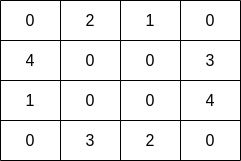
Input:
grid = [[0,2,1,0],[4,0,0,3],[1,0,0,4],[0,3,2,0]]
Output:7
Explanation: The fisher can start at cell(1,3)and collect 3 fish, then move to cell(2,3)and collect 4 fish.
Example 2:
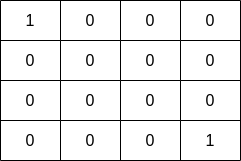
Input:
grid = [[1,0,0,0],[0,0,0,0],[0,0,0,0],[0,0,0,1]]
Output:1
Explanation: The fisher can start at cells(0,0)or(3,3)and collect a single fish.
Constraints:
m == grid.lengthn == grid[i].length1 <= m, n <= 100 <= grid[i][j] <= 10
Test Cases
class Solution:
def findMaxFish(self, grid: List[List[int]]) -> int:import pytest
from solution import Solution
@pytest.mark.parametrize('grid, expected', [
([[0,2,1,0],[4,0,0,3],[1,0,0,4],[0,3,2,0]], 7),
([[1,0,0,0],[0,0,0,0],[0,0,0,0],[0,0,0,1]], 1),
])
@pytest.mark.parametrize('sol', [Solution()])
def test_solution(sol, grid, expected):
assert sol.findMaxFish(grid.copy()) == expected
Thoughts
跟 200. Number of Islands 类似,同样是漫填充算法。
扫描整个区域,如果是陆地则跳过;如果是水,则把鱼收走,并把此位置标记为陆地,将此位置放入栈。每次出栈的位置,都继续检查其上下左右的位置,做同样的判断和处理。
时间复杂度 O(m * n),空间复杂度 O(m * n)(栈的大小)。
Code
class Solution:
    def findMaxFish(self, grid: list[list[int]]) -> int:
        max2 = lambda a, b: a if a >= b else b
        m = len(grid)
        n = len(grid[0])
        dirs = [(-1, 0), (1, 0), (0, -1), (0, 1)]
        max_fish = 0

        for i in range(m):
            for j in range(n):
                if grid[i][j] == 0:
                    continue

                fish = grid[i][j]
                grid[i][j] = 0
                stack = [(i, j)]
                while stack:
                    r, c = stack.pop()
                    for dr, dc in dirs:
                        nr, nc = r + dr, c + dc
                        if 0 <= nr < m and 0 <= nc < n and grid[nr][nc] != 0:
                            fish += grid[nr][nc]
                            grid[nr][nc] = 0
                            stack.append((nr, nc))

                max_fish = max2(max_fish, fish)

        return max_fish
评论需要 JavaScript。